Architecture
Prerequisites: Concepts.
FluxRules is a lightweight rule evaluation engine with a clean layered architecture. This page describes the system design from the DSL down to engine execution.
System Architecture
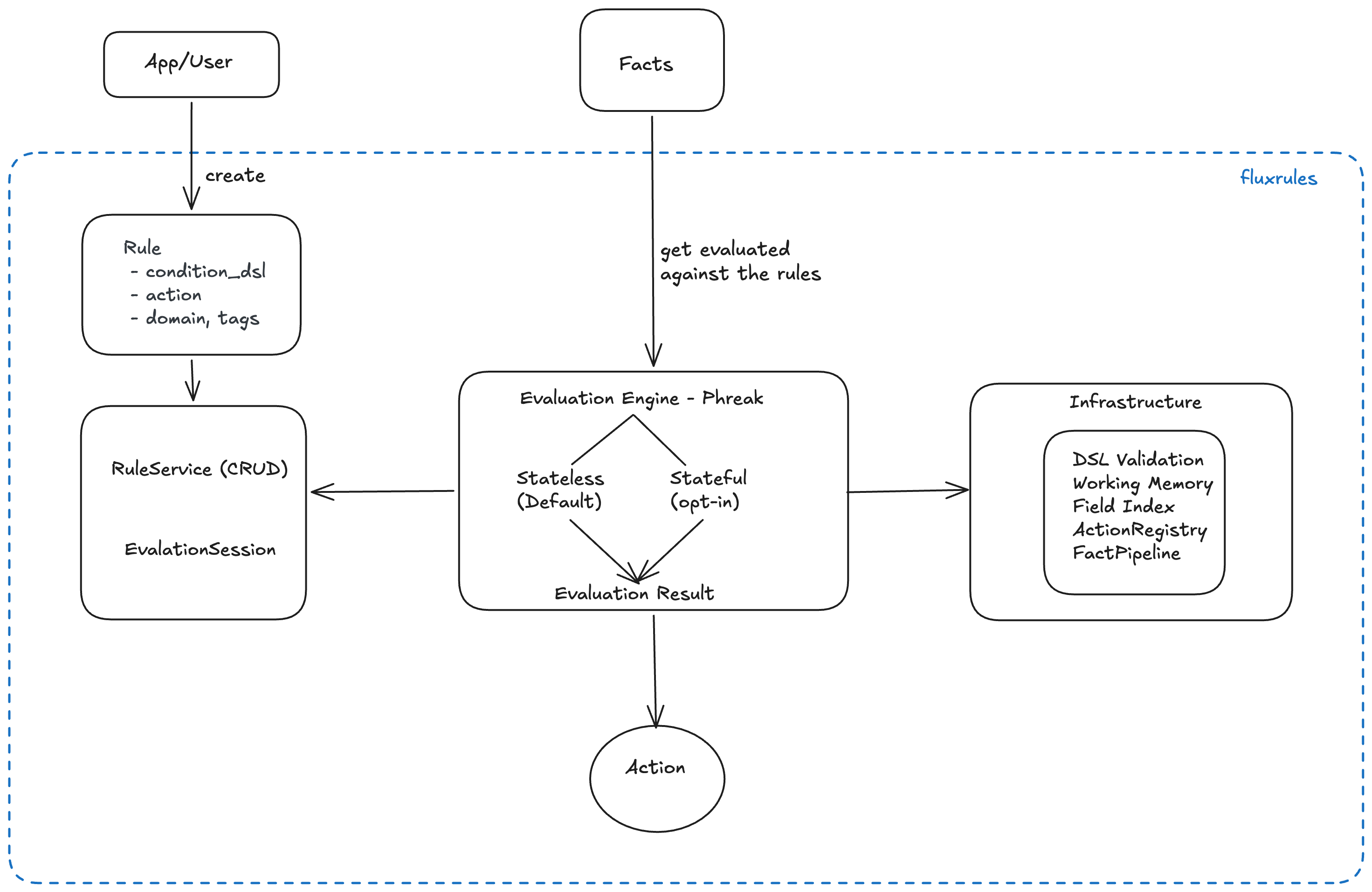
Evaluation Flow: From Fact to Result
Single Fact Evaluation (Simple API)
User: engine.evaluate({"amount": 5000, "country": "NG"})
  │
  ├─→ [1. Validate fact structure]
  │
  ├─→ [2. Iterate loaded rules]
  │    (via the PHREAK network)
  │
  ├─→ [3. For each rule:
  │       - Evaluate condition_dsl against fact
  │       - If matched: add to fired_rules list
  │       - If matched & action exists: execute action
  │
  ├─→ [4. Collect results]
  │    - fired_rules: List[int] (matched rule IDs)
  │    - actions: List[Any] (action results)
  │    - latency_ms: float (execution time)
  │
  └─→ EvaluationResult(fired_rules=[1, 3], actions=["flag"], latency_ms=0.45)
Multi-Step Workflow (Session-Based)
User: session = service.create_session()
  │
  ├─→ [1. Add facts incrementally]
  │    session.add_fact("user_type", "premium")
  │    session.add_fact("amount", 10000)
  │
  ├─→ [2. Evaluate against accumulated facts]
  │    result = session.evaluate()
  │
  ├─→ [3. Session remembers state (optional)]
  │    - Save snapshot for recovery
  │    - Restore in another process
  │
  └─→ EvaluationResult (same structure as simple API)
The Engine: PHREAK
For evaluation modes and selection guidance, see The FluxRules Engine and Choosing an Evaluation Mode.
PHREAK (Phased Evaluation and Knowledge-the single engine)
Data flow:
Load rules → [Store rules list]
              ↓
Fact input → [Linear iteration over rules]
              ├→ For each rule: evaluate condition
              ├→ Match? Add to results
              ↓
          [Produce EvaluationResult]
          ↓
          [Discard working memory for next fact]
Stateless mode (default): - Most HTTP/stateless workloads - Rules added/removed frequently - Low memory footprint required - Single-fact evaluation (typical)
Streaming mode (opt-in)
Data flow:
Load rules → [Build PHREAK network]
              ↓
Fact input → [Assert into working memory]
              ├→ Match new/changed facts
              └→ Report fired delta
              ↓
          [Produce EvaluationResult]
          ↓
          [Working memory persists across calls]
When to use: - Many facts over same rule set within a session - Event streams where only changes matter - Incremental fact updates (assert/retract)
DSL Processing Pipeline
The condition_dsl is a recursive JSON structure that's validated, compiled, and executed:
Input DSL:
{
  "type": "group",
  "op": "AND",
  "children": [
    {"type": "condition", "field": "amount", "op": ">", "value": 5000},
    {"type": "condition", "field": "country", "op": "in", "value": ["NG", "US"]}
  ]
}
  │
  ├─→ [1. Parse & Validate]
  │    - Check syntax (type, op, field names)
  │    - Ensure operator is valid (==, !=, <, >, in, contains, etc.)
  │
  ├─→ [2. Convert to AST]
  │    - Build tree of condition nodes
  │    - Resolve operator functions
  │
  ├─→ [3. Evaluate against fact]
  │    - Traverse AST
  │    - Apply operators to fact values
  │    - Short-circuit AND/OR when possible
  │
  └─→ boolean result (True = rule fires)
Data Model: Rule
# python skip
Rule(
    name="high_value_payment",           # Identifier
    domain="fraud_detection",             # Grouping
    tags=frozenset(["tier_1", "urgent"]), # Cross-cutting labels
    priority=10,                          # Execution order (higher first)
    condition_dsl={...},                  # The DSL above
    action="flag_for_review",             # Or callable
    persist=False                         # Optional: store in database
)
Key design: - Rule is immutable once created (frozen Pydantic model) - Conditions are pure predicates (no side effects) - Actions are simple strings or callables - Domain/tags allow flexible rule organization
Pluggability Points
FluxRules allows extension at three key layers:
1. Custom Engines
# python skip
class MyEngine(BaseEngine):
    def load_rules(self, rules: List[Rule]) -> None: ...
    def evaluate(self, fact: Dict) -> EvaluationResult: ...
2. Custom Actions
# python skip
@action(name="email_alert", category="notifications")
def email_alert(recipient: str, subject: str) -> bool:
    send_email(recipient, subject)
    return True
3. Custom Transforms (FactPipeline)
# python skip
class UpperCase(Transform):
    def apply(self, fact: Dict) -> Dict:
        return {k: v.upper() if isinstance(v, str) else v for k, v in fact.items()}
Deployment Layers
Standalone (Single Process)
┌──────────────────────┐
│  Your Application    │
│  ├─ PhreakEngine     │
│  └─ Rules            │
└──────────────────────┘
Service-Based (HTTP)
┌──────────────────────┐
│  HTTP Client         │
│  └─ POST /evaluate   │
└──────────┬───────────┘
           │
┌──────────▼───────────┐
│  FastAPI Server      │
│  ├─ RuleService      │
│  ├─ PhreakEngine     │
│  └─ Rules (database) │
└──────────────────────┘
Distributed (Microservices)
┌──────────────────────┐     ┌──────────────────────┐
│  Rule Editor         │────▶│  Rule Repository     │
└──────────────────────┘     └──────────┬───────────┘
                                        │
                    ┌───────────────────┼───────────────────┐
                    │                   │                   │
            ┌───────▼───────┐  ┌────────▼───────┐  ┌────────▼───────┐
            │  Engine Pod 1  │  │  Engine Pod 2  │  │  Engine Pod 3  │
            │  PhreakEngine  │  │  PhreakEngine  │  │  PhreakEngine  │
            │  (cached rules)│  │  (cached rules)│  │  (cached rules)│
            └────────────────┘  └────────────────┘  └────────────────┘
Design Principles
- Evidence-first: All documentation backed by working code
- Pydantic v2: Rule validation via Pydantic (not home-grown)
- Pluggable: Custom engines, actions, transforms via simple interfaces
- Fast: Production-grade performance (ms-level latency)
- Simple: Minimal API surface, small learning curve
- Lazy by default: PHREAK's on-demand evaluation minimizes overhead